
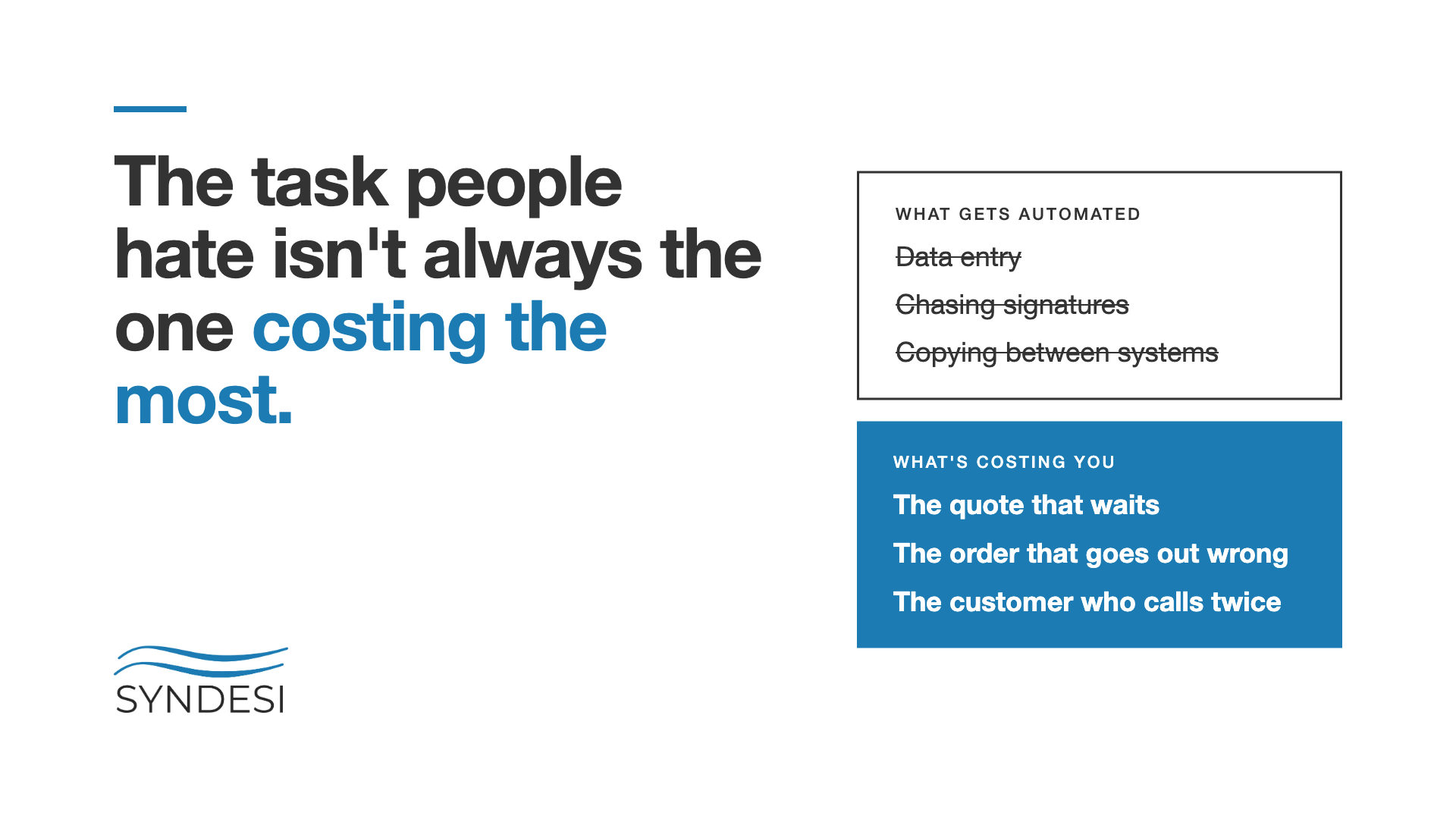
The task people hate isn't always the one costing the most.
The task people hate isn't necessarily the one costing the business the most. Find where the money is going first.
Ask a business owner what they'd automate and you'll usually get an answer before you've finished the question.
Data entry. Chasing signatures. Copying information from one system into another.
I get it. Those jobs are repetitive, frustrating, and easy to identify. Everyone knows who gets stuck doing them.
But the task people hate isn't necessarily the one costing the business the most.
Before spending money on business process automation, I'd want to understand where work is slowing down, getting done twice, or quietly costing the company customers.
That's often a different list.
The cost isn't always sitting in a task
Repetitive work is easy to name. A bottleneck isn't.
It often sits between people, departments, or systems. Nobody considers it a separate task because it's simply how things have always worked.
A quote sits waiting for approval. A change never reaches production. A customer calls twice because nobody followed up the first time.
These problems don't always show up in a report. They're absorbed into the normal workweek.
And because nobody is specifically responsible for fixing them, they keep happening.
You can eliminate hours of data entry and still have those same delays costing you money.
Three places the cost hides
These aren't unusual problems. They happen in manufacturing companies, service businesses, distributors, and agencies every week.
The quote that waits.
A customer asks for a price. The sales rep has most of the information, but there's an exception that only one person can approve.
Two days go by.
Nobody considers the process broken. It's just how pricing works.
Meanwhile, the customer is getting another quote from someone else.
The company might never know whether that delay cost them the business. But it certainly didn't help.
The order that goes out wrong.
A customer changes a specification. The update comes by text or email, but it never makes it to the person handling production.
The order ships against the old instructions.
Now someone has to explain the mistake, arrange a replacement, absorb a discount, or remake the order.
The problem wasn't that people weren't working hard enough. The information simply didn't reach the right person.
And the cost shows up long after the original mistake.
The customer who calls twice.
A customer reaches out with a question. The answer exists somewhere in the business, but nobody owns the request.
They call back the next day, less patient than they were the first time.
Someone scrambles to find the information.
What should have been a simple answer becomes an interruption for three people and a frustrated customer.
None of these situations necessarily appears on an automation wish list.
They don't feel like tasks. They feel like business as usual.
How do you decide what to automate first?
This is where I'd spend time before building anything.
Pick one recurring process. Follow several actual jobs from the initial request through completion.
Quotes, orders, customer inquiries, whatever happens frequently enough that the same problems have a chance to repeat.
Sit with the people doing the work. Not just their managers.
Ask three questions:
- What are you waiting on?
- Who do you go to when something gets stuck?
- What do you have to check before the work can move forward?
Then look at what happened.
How long did the work sit? How often did someone have to redo something? How many people got pulled into solving a problem that should have been routine?
Put some numbers against it, even if they're estimates.
A ten-minute annoyance once a week is different from a two-day delay affecting five quotes.
Both are worth addressing. They probably shouldn't get the same priority.
You don't need a month of workshops to figure this out. You need to follow the work and pay attention to where it stops.
Sometimes the right fix isn't AI
Not every bottleneck requires software, much less AI.
Sometimes it's a shared inbox with a clear owner.
Sometimes it's a required field that prevents an incomplete order from reaching production.
Sometimes it's documenting the pricing exceptions that currently live in one employee's head.
Those changes aren't particularly interesting to talk about. But if they eliminate delays and mistakes, who cares?
AI becomes useful when there's a defined piece of work it can make faster or more reliable.
It might prepare the information needed for a quote, flag a missing document before an order is processed, or organize customer communications so someone can respond without searching through three systems.
A person can still review and approve the result.
But if nobody knows which record is correct, who owns the next step, or what approval is required, adding AI doesn't solve that confusion.
It just moves it somewhere else.
A tool that produces an answer in two minutes but requires an hour to verify hasn't saved anyone much time.
Fix what is costing you first
The useful question isn't simply, "What work can we automate?"
It's whether fixing a particular step will improve something that matters to the business.
Will quotes get out faster?
Will fewer orders need to be remade?
Will customers get answers without having to chase someone?
Will employees spend less time correcting mistakes and more time doing the work they were hired to do?
Those are outcomes worth measuring.
The task everyone complains about may deserve attention. Sometimes it really is the right place to start.
But I'd rather fix the delay that's costing a company business than save ten minutes on a task everyone hates.
Find where the money is going first.
Then decide what technology, if any, belongs there.
About Peter Belanger
Peter Belanger is the founder of Syndesi. He writes about business development, better workflows, and where AI is worth using.
Tell us about your business